
Several carmakers, including car market leader Maruti Suzuki India pulled the plug on diesel models citing higher costs for BSVI variants leaving buyers with limited options.

Prime Minister Narendra Modi on Tuesday announced the signing of the India-EU Free Trade Agreement (FTA), saying it accounts for 25 per cent of global GDP and one-third of global trade.
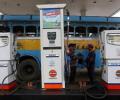
Movement of prices in international oil market and rupee-USD exchange rate will be monitored
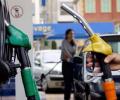
In the first reduction in rates in over a year, petrol price on Wednesday was cut by 18 paise per litre and diesel by 17 paise a litre as international oil prices tumbled to the lowest since early February.

For the third time in two months, state-owned oil firms on Thursday slashed prices of petrol and diesel by over a rupee, in step with the global softening of crude prices.
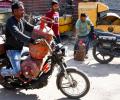
Cooking gas or Liquified Petroleum Gas (LPG) price has been raised by Rs 50 per cylinder by distribution companies, Union Oil Minister Hardeep Singh Puri said on Monday.
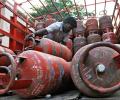
Prime Minister Narendra Modi on Friday announced a Rs 100 per cylinder cut in cooking gas LPG price to ease financial burden on households. Non-subsidised cooking gas price will be cut to Rs 803 per 14.2-kg cylinder in the national capital with effect from midnight of Friday/Saturday, official sources said. Prices vary from state to state depending on the incidence on local taxes.
This is perhaps the first time that retail prices in India are higher than the global rates

Customers have started to factor in the narrowing gap between petrol and diesel and the premium that needs to be paid for a diesel vehicle.
At one end the petrol motors have been criticised for consuming high fuel while on the other the diesel motors have also been condemned for being noisy and low powered.

Since August, petrol price has been cumulatively cut by Rs 9.36 per litre.

While the share of diesel vehicles sales in the overall passenger car industry has already fallen sharply, sales of CNG vehicles have shown a compound annual growth rate of 15.5 per cent over the past five years.

Lower fuel subsidy payouts might restrict gross fiscal deficit in FY15.
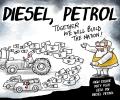
Dominic Xavier offers his take on the latest blow to personal finances.

India, the world's third-largest oil consumer, spent 2.5 billion euro on buying crude oil from Russia in September, 14 per cent less than the previous month, a European think tank said. India remained the second-largest buyer of Russian fossil fuels in September behind China, according to the Centre for Research on Energy and Clean Air (CREA).
Under-recovery or the gap between retail selling price and the cost of import, this month dipped to an all-time low of 8 paise a litre, helped by the monthly increases and softening in international oil rates.

Reliance Industries Ltd on Thursday said it has halted the use of Russian crude at its export-only refinery in Jamnagar, Gujarat, as the company moves to comply with European Union sanctions. Reliance is India's largest buyer of Russian oil, which it processes and turns into fuel, such as petrol and diesel, at its giant oil refining complex at Jamnagar.

In absolute terms, both types of cars must cut emissions by about 28-29 g/km. But in percentage terms, the lighter 900-kg car must reduce emissions by 27 per cent, while the 1,500-kg car needs a 22 per cent cut. And the target becomes progressively stringent for both -- but, once again, the tightening is sharper for the 900-kg car than for the 1500-kg car.

'We are seeing a lot of people with helmets visiting our showrooms.'

Jet fuel prices on Wednesday were hiked by over 18 per cent -- the steepest ever increase -- to all-time high levels after international oil price surged to a multi-year high.

The Curvv hasn't set the sales charts on fire and Tata needs another product aimed straight at the Hyundai Creta, which is where the Sierra fits in.

BMW India CEO says gradual five-year import duty cuts under new FTAs create buyer hesitation and urges government to announce year-wise rates instead.

Petrol and diesel price on Sunday was hiked again by 35 paise a litre and the auto fuels now cost a third more than the rate at which ATF is sold to airlines. The fourth straight day of 35 paise per litre hike sent petrol and diesel rates to record highs across the country. The price of petrol in Delhi rose to its highest-ever level of Rs 105.84 a litre and Rs 111.77 per litre in Mumbai, according to a price notification of state-owned fuel retailers.

The Andhra Pradesh government has prepared an action plan for relief and essential supplies in pre-cyclone preparedness for Cyclone Montha, expected to cross the coast on October 28.
The government has cut petrol price by Rs 5 and diesel by 2 a litre with effect from midnight tonight.

Tata Motors Passenger Vehicles Ltd expects contribution of SUVs to its overall sales to go beyond 70 per cent with it making foray into the fast growing mid-sized segment with a premium positioning of its Sierra model, according to its Managing Director & CEO, Shailesh Chandra.
'Primary buyers are commercial taxi and fleet operators and small businessmen.' 'CNG prices have been remarkably stable unlike petrol.'

Between January and August 2025, over 65,000 units of the Bolero were sold, making it the third-highest contributor to Mahindra's overall SUV sales. Bolero annually achieves sales of over 1 lakh units.

Jet fuel prices on Monday were hiked by a steep 5.3 per cent - the tenth straight increase this year -- to an all-time high, in line with a surge in global energy prices. The price of aviation turbine fuel (ATF) -- the fuel that helps aeroplanes fly -- was hiked by Rs 6,188.25 per kilolitre, or 5.29 per cent, to Rs 1,23,039.71 per kl (Rs 123 per litre) in the national capital, according to a price notification of state-owned fuel retailers. This is the 10th straight increase in jet fuel prices this year.

Petrol price was hiked by 30 paise per litre and diesel by 35 paise a litre, according to a price notification of state-owned fuel retailers. The seventh straight day of price hike pushed fuel rates to a new record high. The price of petrol in Delhi rose to its highest-ever level of Rs 104.44 a litre and Rs 110.41 per litre in Mumbai, the notification showed. In Mumbai, diesel now comes for Rs 101.03 a litre; while in Delhi, it costs Rs 93.17.
Petrol price cut by 50 paisa a litre; diesel by 46 paisa.

The offroad legend 2025 Mahindra Thar launched at an eye-popping Rs 9.99 lakh, writes Rajesh Karkera/Rediff.com.
The government had, on June 25, freed petrol price from its control resulting in a hike of Rs 3.50 per litre.

A decision on raising diesel prices by Rs 3-5 per litre, kerosene by Rs 2 and LPG by up to Rs 50 per cylinder will be taken after UPA Chairperson Sonia Gandhi returns from US, top government officials said.

OMCs are currently incurring daily under-recovery of Rs 230 crore.
It is the seventh reduction in jet fuel rates since August

Diesel price needs to be revised upward, or subjected to higher taxes, as misuse of subsidized diesel was adding to pollution and public health costs, the government's pre-budget economic report card said on Thursday.
Diesel price needs to be revised upward, or subjected to higher taxes, as misuse of subsidized diesel was adding to pollution and public health costs, the government's pre-budget economic report card said on Thursday.

The GST Council on Wednesday approved two slabs of 5 per cent and 18 per cent effective from September 22, the first day of Navaratri.

Additionally, road cess on petrol was raised by Re 1 per litre each on petrol and diesel to Rs 10.
